For more than a century, the Nevada desert kept its secret beneath the sand.
Then, after one violent windstorm, the past resurfaced.
What first appeared to be the remains of an old frontier saloon soon became something far more disturbing: a hidden crime scene, sealed away by time, silence, and the shifting dunes. When Sheriff Walter Hutton stepped inside the buried building, he was not simply walking into an abandoned relic of the Wild West.
He was entering the forgotten center of a murder investigation.
And behind the bar, beneath a dust-covered rug, lay the first clue to a mystery that had haunted local history since 1906.
A Strange Discovery After the Sandstorm
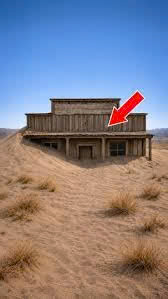
The morning after the storm, Sheriff Walter Hutton was patrolling the Nevada dunes when he noticed something unusual protruding from the sand. At first glance, it looked like broken timber. But as he moved closer, the shape became impossible to ignore.
There were walls.
A roofline.
The remains of an entrance.
It was an old American saloon, buried almost completely beneath the desert.
Hutton called his deputy for assistance, and together they spent hours clearing the sand from the doorway. When the entrance was finally exposed, the warped wooden door gave way with a long, strained creak — as if the building had been waiting decades to breathe again.
Inside, the air was stale and heavy. Poker chips still lay scattered across dusty tables. Whiskey bottles rested untouched on the shelves. Chairs were overturned, frozen in place like the aftermath of a sudden panic.
It did not feel like an abandoned bar.
It felt like a room where something had gone terribly wrong.

The First Clue Behind the Bar
As Hutton moved behind the mahogany counter, his flashlight swept across the floorboards. That was when he saw the marks.
Deep scratches cut into the wood.
They were too sharp, too deliberate, and too chaotic to be ordinary damage. The marks appeared to drag across the floor toward a heavy rug lying behind the bar.
The rug itself seemed out of place. It was not positioned for decoration. It looked as though it had been placed there to hide something.
Hutton pulled it aside.
Beneath it was a reinforced trapdoor, sealed shut with a rusted padlock.
At that moment, the discovery changed from an archaeological curiosity into a possible crime scene.

The Locked Cellar Beneath the Saloon
Using bolt cutters, Hutton snapped the old lock. The moment he lifted the trapdoor, a wave of damp, stale air rose from the darkness below.
He aimed his flashlight into the cellar.
Then he froze.
At the bottom of the hidden room were three skeletons, huddled together in the far corner. Their clothing had decayed over time, but one detail remained visible.
Tarnished brass stars still clung to their chests.
They were Federal Marshals.
The discovery immediately connected the buried saloon to one of the region’s oldest unsolved mysteries: the disappearance of three federal lawmen in 1906.
The Cold Case That Never Had a Body
Historical records later revealed that the three marshals had vanished while investigating a corrupt local gang believed to be involved in smuggling, extortion, and violent intimidation across the region.
At the time, the case shocked the community. But without bodies, witnesses, or physical evidence, the investigation eventually collapsed into rumor.
Some believed the marshals had been murdered.
Others claimed they had fled.
A few whispered that the gang had made them disappear beyond the state line.
But the hidden cellar suggested a darker truth.
The marshals had not vanished into the desert.
They had been trapped beneath the saloon the entire time.

A Trap Hidden in Plain Sight
The evidence inside the saloon pointed toward a violent ambush.
The scratch marks behind the bar suggested a struggle. The reinforced trapdoor indicated that the cellar was not an ordinary storage space. And the way the bodies were found — gathered together in the corner — suggested the men may have spent their final moments trapped in total darkness.
Investigators believed the marshals were likely attacked while pursuing the gang. They may have been overpowered, dragged behind the bar, forced into the cellar, and locked inside while still alive.
The most chilling detail was the room itself.
According to the account, the cellar appeared to have been reinforced in a way that could have muffled sound. If true, their cries for help would never have reached the saloon above.
The building became both a hiding place and a tomb.
How the Desert Hid the Crime for Over a Century
After the marshals disappeared, the saloon eventually vanished too. Over the years, shifting sand swallowed the structure, burying the bar, the trapdoor, the cellar, and the evidence of what had happened there.
For more than 100 years, the crime remained concealed beneath the Nevada dunes.
No trial.
No confession.
No justice.
Only the silence of the desert.
Then the windstorm came, stripping away the sand and exposing the forgotten building. Nature did what investigators in 1906 could not: it reopened the scene of the crime.

Conclusion: Some Secrets Do Not Stay Buried Forever
The buried saloon was more than a relic of the American frontier. It was a sealed crime scene, preserved by sand and time. Every detail — the scattered poker chips, the overturned chairs, the scratches on the floor, the hidden trapdoor, and the three brass stars in the cellar — pointed to a mystery that had waited more than a century to be uncovered.
The Nevada desert had hidden the truth for generations.
But the truth was never gone.
It was only buried, waiting for the right storm to bring it back into the light.