The extraordinary find was announced by the Institute of Archaeology of the Russian Academy of Sciences (RAS), whose 2025 campaign in the Chechen Republic has become one of the most significant in recent decades. The excavations spanned multiple ancient settlements and burial grounds, uncovering artifacts that trace the region’s history from the Late Chalcolithic period through the Middle Ages.
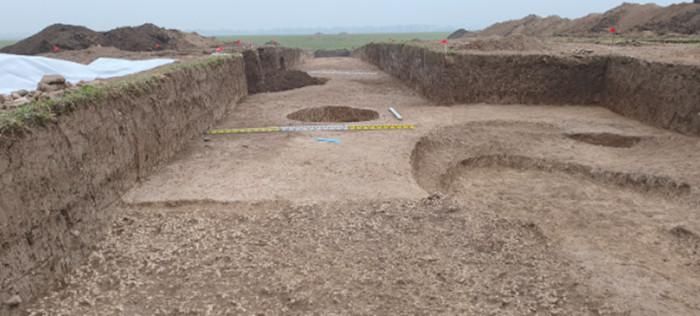
View from the west of the excavation site with archaeological sites. (Institute of Archaeology RAS)
Unveiling the Khumyk-2 Necropolis
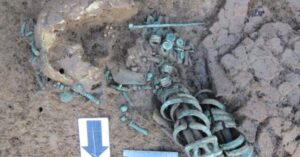
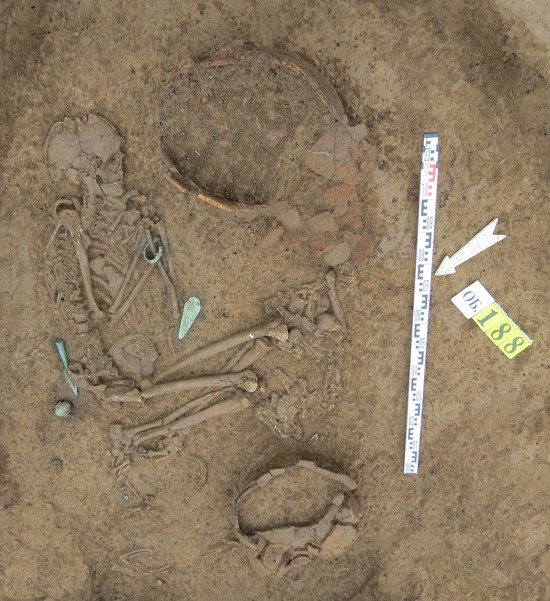
The woman’s remains were discovered at the Khumyk-2 burial ground, a vast site that archaeologists estimate may contain up to 2,000 graves. Researchers examined 160 burials belonging to the Eastern Koban culture, which flourished from the 10th to the first half of the 8th century BC. This particular Bronze Age burial stood out due to the sheer volume of grave goods, with some burial inventories at the site containing up to 60 distinct items.
The presence of 19 heavy bronze bracelets on a single individual is highly unusual and suggests that the woman held a prominent role within her community. Archaeologists believe that such elaborate adornment went beyond mere aesthetic preference, likely serving as an indicator of elite status, tribal affiliation, or specific ritual significance within the broader context of ancient Caucasian societies.
Bronze weapons found alongside male remains at the Khumyk-2 archaeological site. (Institute of Archaeology RAS)
According to a report by Heritage Daily, the deceased were consistently placed in a crouched position on their left side, with their heads oriented toward the south-east. While female graves were typically furnished with ceramic vessels, hairpins, and bracelets, male burials painted a different picture. The men were often accompanied by an array of weapons, including bronze daggers, spearheads, and stone maces, highlighting the distinct societal roles of an ancient warrior class.
Rituals and Bronze Age Metallurgy
The 2025 expedition extended far beyond the Khumyk-2 necropolis, covering over 10,000 square meters across four major sites. At the Tyalling-2 settlement, which dates back to the Late Chalcolithic period in the 4th millennium BC, archaeologists uncovered domestic structures alongside nine distinct sacred areas. These ritual spaces featured clay platforms, altars, and complexes containing broken pottery and animal bones, suggesting a deeply ingrained spiritual life among these early nomadic and settled communities.
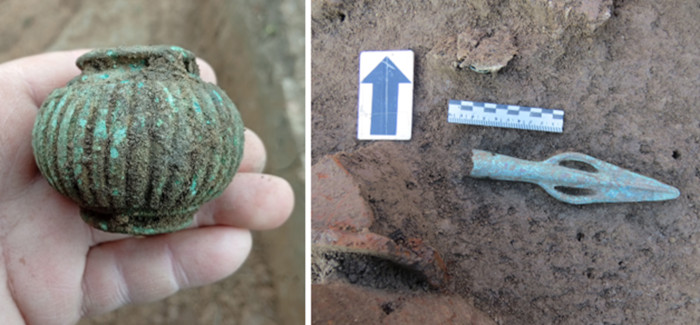
A bronze mace head and spear head recovered during the Chechnya excavations. (Institute of Archaeology RAS)
Further exploration at the Iskrinskoye-1 site revealed a complex metallurgical center from the 3rd millennium BC. Beneath layers of a medieval settlement, the team found casting molds, clay nozzles, and furnaces containing oxidized copper splashes. As noted by Arkeonews, one large structure housed multiple types of furnaces, proving that advanced industrial metalworking was seamlessly integrated into everyday domestic activities rather than being isolated from the community.
A Window into Medieval Migration
The timeline of the discoveries stretches well into the Middle Ages, particularly at the Mayrtup settlement and burial complex. Spanning the 6th to 13th centuries AD, this site yielded over 250 archaeological features, including kurgans with square ditches characteristic of the early Alanian culture. These findings indicate a period of significant migration and cultural exchange, echoing the dynamic movements of Scythian and Alanian populations across the region.
Although many of the medieval graves had been subjected to ancient looting, archaeologists still managed to recover nearly a thousand ceramic fragments and hundreds of everyday objects. These artifacts, along with the stunning Bronze Age burial of the woman with 19 bracelets, will undergo extensive laboratory analysis before being preserved at the National Museum of the Chechen Republic. This meticulous work ensures that the rich heritage of the North Caucasus is protected and studied for future generations.